Quick Tour of Temper#
Temper is a programming language and toolchain for making libraries that can be used natively from any other language.
Temper compiles to idiomatic types and functions for each target language: currently C++, C#, Java, JavaScript, Lua, Python, and Rust, with plans for many more. Whether you're an open-source developer or work in an enterprise, Temper can multiply the reach and effect of your work. "Why a new programming language?" explains what Temper lets you do that existing languages don't.
Get started, or see examples below for a quick tour.
Examples#
Translate#
Temper lets you define rich data types and logic that translate to all supported backend languages. Usage is idiomatic in each language.
export class Person(
  public birthDate: Date,
) {
  public ageAt(date: Date): Int {
    // Or support other definitions of age.
    Date.yearsBetween(birthDate, date)
  }
}
Use from:
Note: these snippets construct a
Dateexported by the library itself. Withstd/temporal'sDate, each language would use its own date type, such asDateTimein C#,LocalDatein Java, anddatetime.datein Python (inconsistencies).
C#
using Snippets.Person;

var person = new Person(new Date(1987, 6, 5));
var age = person.AgeAt(new Date(2023, 2, 1));
Console.WriteLine($"Age: {age}");
Java
import snippets.person.*;

class Use {
    public static void main(String[] args) {
        var person = new Person(new Date(1987, 6, 5));
        var age = person.ageAt(new Date(2023, 2, 1));
        System.out.printf("Age: %s\n", age);
    }
}
JS / TS
import { Date, Person } from "snippets/person.js";

let person = new Person(new Date(1987, 6, 5));
let age = person.ageAt(new Date(2023, 2, 1));
console.log(`Age: ${age}`);
Lua
local p = require("snippets.person")

local person = p.Person(p.Date(1987, 6, 5));
local age = person:ageAt(p.Date(2023, 2, 1));
print("Age: " .. math.floor(age));
Python
from snippets.person import Date, Person

person = Person(Date(1987, 6, 5))
age = person.age_at(Date(2023, 2, 1))
print(f"Age: {age}")
Dispatch#
Use interfaces for abstraction. And use familiar syntax.
export interface Shape {
  public perimeter(): Float64;
}

export class Rectangle(
  public width: Float64,
  public height: Float64,
) extends Shape {
  public perimeter(): Float64 { 2.0 * (width + height) }
}

let tau = 2.0 * Float64.pi;

export class Circle(
  public radius: Float64,
) extends Shape {
  public perimeter(): Float64 { tau * radius }
}
When#
Or match on types instead of using virtual dispatch.
export let area(shape: Shape): Float64 {
  when (shape) {
    is Rectangle -> shape.width * shape.height;
    is Circle -> do {
      let { radius } = shape;
      0.5 * tau * radius * radius
    }
    else -> NaN; // needed until exhaustiveness checks
  }
}
Test#
Test your code across languages. Temper test integrates with well-known frameworks such as
JUnit, Mocha, and Pytest. You can test your libraries in Temper to build confidence
in its correctness and also build confidence in each translation's fidelity.
test("age") {
  let person = new Person(new Date(1987, 6, 5));
  let age = person.ageAt(new Date(2023, 2, 1));
  // You can give a custom failure message callback.
  assert(age == 35) { "Bad age: ${age}" }
  // Or just use automatic messaging.
  // Reports "expected age == (36) not (35)"
  assert(age == 36);
}
Document#
Embed your Temper code inside of Markdown. Collaborate with others on lightweight standards documents that include a reference implementation. Translate the implementation to many programming languages.
## Circle

Tau (τ) is a full turn in radians, rather than the half turn of pi (π).

    let τ = 2.0 * Float64.pi;

    export class Circle(
      public radius: Float64,
    ) {

Using `τ` rather than `π` simplifies some calculations and complicates
others.

      public perimeter(): Float64 { τ * radius }
    }
Develop#
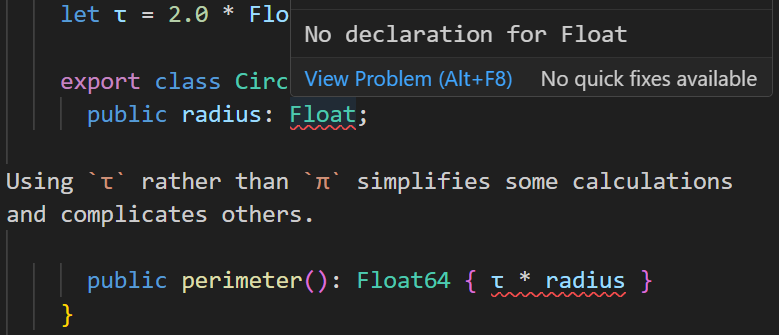
Temper has a language server and an extension for Visual Studio Code (editors). Great tooling helps Temper users discover language features and iterate quickly, so we'll continue to prioritize it.
Next steps#
Excited about Temper?
- Get started
- Or read the reference documentation.
Problems, Questions, Discussion?#
- Questions? The Stack Overflow [temper] tag is a great place to ask.
- Ideas, or just want to chat? The Temper Language Discord is a great place to share your thoughts on Temper or talk about what you've done with it.
- If you have a problem or feature request, check the issue tracker.